


*Tunisia: Oum Ettamer, Medenine 4111
*France: 28 Rue du Guet, Clamart 92140 FR
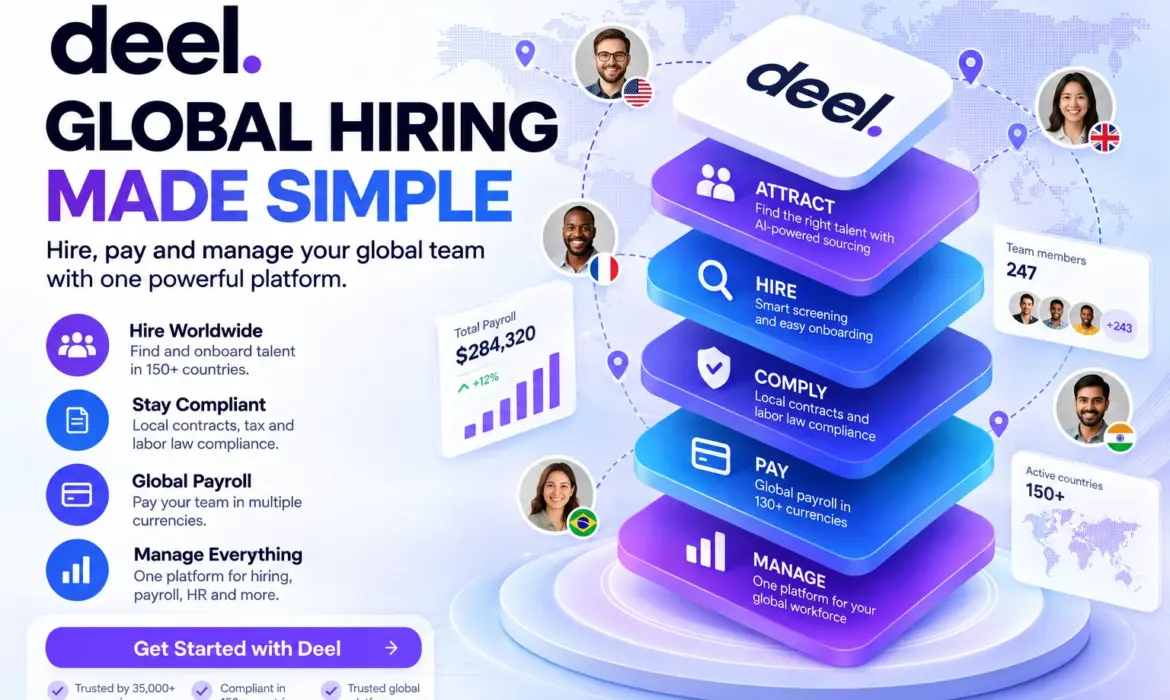
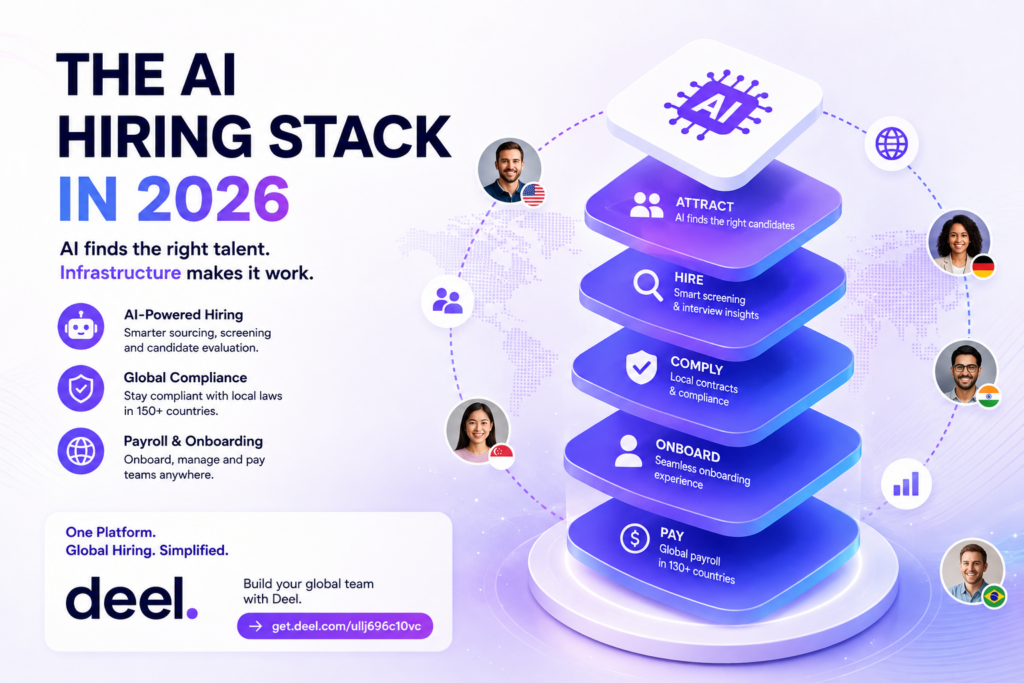
Connect AI-powered recruitment with the employment, compliance and payroll infrastructure you need to hire globally with confidence.
Explore Deel for Global Hiring →AI is changing almost every step of recruitment. But finding the right candidate is only half the challenge. The real competitive advantage comes from connecting AI-powered hiring with compliant global employment, onboarding, and payroll.
In 2026, hiring is no longer a simple process of publishing a job, reviewing resumes, conducting interviews, and sending an offer.
Artificial intelligence is increasingly becoming part of the entire hiring workflow.
AI can help companies identify workforce needs, create job descriptions, source candidates, analyze applications, summarize interviews, and accelerate decision-making. But once a candidate accepts an offer, another layer becomes critical: how do you legally employ, onboard, manage, and pay that person?
This is where the modern AI Hiring Stack becomes more than an HR technology problem.
The future of global hiring is not simply AI recruiting.
It is AI-powered recruiting connected to global HR, compliance, and payroll infrastructure.
Once payroll data needs to flow into financial records, cloud accounting becomes another layer of the stack. Our Xero Review 2026 explains how Xero handles accounting, invoicing, bank reconciliation, reporting, and automation for businesses evaluating cloud accounting software.
The AI Hiring Stack is the collection of technologies that help organizations move from workforce planning to a completed hire and, ultimately, an active employee or contractor.
A simplified 2026 workflow looks like this:
Workforce Planning → Job Creation → Candidate Sourcing → AI Screening → Interviews → Evaluation → Offer → Compliance → Onboarding → Payroll → Workforce Management
Each layer solves a different problem.
The interesting shift is that AI is moving from being a tool used by recruiters to becoming an intelligence layer across the entire workflow.
However, automation does not eliminate responsibility.
Companies still need to make sure hiring decisions are fair, employment relationships are correctly structured, contracts comply with local regulations, and workers are paid according to applicable laws.
That distinction is becoming increasingly important as governments introduce rules around AI and employment.
The European Union’s AI Act, for example, treats certain AI systems used for recruitment and selection as high-risk, with requirements designed around issues including risk management, data quality, transparency, and human oversight.
The first stage of hiring happens before a job advertisement exists.
Companies need to answer questions such as:
AI can help analyze workforce data and identify patterns that would be difficult to discover manually.
For example, an organization could use AI to identify a growing workload in a particular department and recommend hiring additional talent before the team becomes overloaded.
This changes workforce planning from a reactive process into a more data-driven process.
Instead of:
“We need another engineer because the team is overwhelmed.”
The organization can move toward:
“Based on workload, project timelines, available capacity, and business growth, we will probably need three additional engineers within the next quarter.”
That is the first layer of the AI Hiring Stack.
Once the organization knows what it needs, the next step is creating the job.
Generative AI can dramatically reduce the time required to create job descriptions, competency frameworks, interview questions, and candidate communications.
Recruiters can provide a few requirements and use AI to generate a structured job description.
But speed is not the only benefit.
AI can also help organizations make job descriptions more consistent, identify unclear requirements, and tailor descriptions to different markets.
For global companies, localization becomes particularly important.
A job description designed for a U.S. market may not communicate compensation, employment expectations, or benefits in the same way as one designed for Germany, Singapore, Brazil, or the United Kingdom.
The best AI hiring workflows therefore combine automation with human review.
AI creates the first version.
Recruiters and hiring managers provide the judgment.
Candidate sourcing is another area where AI can change the economics of recruiting.
Instead of relying entirely on manual searches, recruiters can use AI to identify candidates based on skills, experience, location, career history, and other relevant criteria.
This creates an opportunity to move beyond traditional keyword matching.
For example, a recruiter looking for a software engineer might search for a specific combination of technical capabilities rather than simply searching for a particular job title.
AI can potentially identify candidates whose previous job titles are different but whose skills match the role.
This matters in a global labor market where talented people may use different titles, languages, and career paths.
The result can be a larger and more diverse talent pool.
But this is also where organizations need to be careful.
If the underlying data contains historical bias, AI can reproduce or amplify that bias.
Recent legal developments have demonstrated that AI-based hiring is already receiving serious scrutiny. In June 2026, Reuters reported that a California lawsuit involving Workday’s AI-based hiring technology was allowed to proceed, highlighting concerns around potential discrimination in automated screening.
AI can accelerate sourcing.
It should not eliminate accountability.
Screening hundreds or thousands of applications is one of the most obvious applications for AI.
An AI system can help recruiters:
This can dramatically reduce administrative workload.
But organizations should avoid treating an AI-generated ranking as an unquestionable hiring decision.
The strongest model is AI-assisted screening with human oversight.
AI handles repetitive analysis.
Humans remain responsible for understanding context.
This is especially important for international hiring, where education systems, job titles, career paths, and professional qualifications can vary significantly between countries.
A candidate who appears less relevant to an automated system may actually be an excellent fit once a human recruiter understands the context.
The next layer is the interview.
AI can help prepare interview questions, generate role-specific evaluation frameworks, summarize interview notes, and organize feedback from multiple interviewers.
This can improve consistency.
Imagine a company hiring 50 people across five countries.
Without a standardized process, different interviewers may evaluate candidates using completely different criteria.
AI can help create a common framework.
For example:
Technical Skills — 30%
Problem Solving — 25%
Communication — 20%
Relevant Experience — 15%
Role-Specific Competencies — 10%
The exact weighting should come from the organization, not the AI.
That distinction matters.
AI should support structured decision-making rather than become an invisible decision-maker.
This is the point where the AI Hiring Stack becomes significantly more complicated.
Finding a candidate is one thing.
Employing that candidate correctly is another.
Consider a company headquartered in the United States that wants to hire:
The recruitment workflow might be almost identical.
The employment workflow is not.
Each country can have different rules around:
This creates what can be called the Global Compliance Gap.
AI can identify a promising candidate in seconds.
It cannot make employment law disappear.
This is arguably the most important layer of the modern global hiring stack.
Companies expanding internationally need to understand whether a worker should be hired as an employee, contractor, or through another employment structure.
They also need to understand local employment requirements.
For example, misclassifying an employee as an independent contractor can create legal and financial exposure.
Payroll introduces another layer of complexity.
Every country can have different tax rules, reporting requirements, social contributions, benefits, payment systems, and deadlines.
As a company’s workforce expands internationally, managing these requirements manually becomes increasingly difficult.
This is why global hiring platforms have become an important part of the modern HR technology stack.
This is where Deel fits into the AI Hiring Stack.
Deel describes its platform as a global system for hiring, paying, and managing teams across 150+ countries, covering areas such as global payroll, compliance, HR, benefits, and workforce management.
The key idea is simple:
AI can help companies decide who to hire. Infrastructure helps companies employ that person correctly.
Deel’s Employer of Record infrastructure can allow companies to hire employees internationally without establishing their own local entity in every market. Deel states that its EOR offering supports employment across 130+ countries, including payroll, tax, and compliance capabilities.
For companies that already have their own entities, global payroll becomes another critical component.
Deel states that its payroll solution supports compliant payroll across 130+ countries, including automation around areas such as tax filings, statutory contributions, and payslips.
That creates an important separation of responsibilities:
AI → Intelligence and automation
Deel → Employment infrastructure
Humans → Judgment and accountability
The biggest opportunity in 2026 is not necessarily another standalone AI recruiting tool.
It is connecting the entire workflow.
Imagine this scenario.
A company decides it needs a cybersecurity engineer.
AI analyzes workforce requirements and identifies the need for an additional engineer.
AI creates a structured job description based on the required competencies.
AI helps identify suitable candidates across multiple markets.
AI analyzes applications and helps recruiters prioritize candidates.
AI assists with interview preparation, structured evaluation, and summaries.
Human hiring managers make the final decision.
The company determines the appropriate employment structure and country-specific requirements.
The selected candidate receives the appropriate employment documentation and onboarding workflow.
The employee enters the correct payroll process for their jurisdiction.
The employee becomes part of the organization’s ongoing HR, payroll, benefits, and workforce-management systems.
This is the real promise of the modern hiring stack:
A continuous workflow instead of disconnected tools.
One of the biggest mistakes companies can make is treating compliance as something that happens after recruitment.
It should be designed into the workflow from the beginning.
Imagine an AI system recommends hiring a candidate in a country where the company has no entity.
The recruitment team may consider the candidate an excellent fit.
But the organization still needs to determine:
How will this person legally work for the company?
This is why global employment infrastructure needs to be connected to hiring decisions.
The question is no longer simply:
“Can we hire this person?”
It becomes:
“Can we hire this person in this location, under the correct employment structure, while managing payroll and compliance requirements?”
That is a much more valuable question.
Despite the rapid development of AI, the future of hiring is unlikely to be completely autonomous.
Human judgment remains essential.
Recruiters and hiring managers need to evaluate:
There is also an important governance responsibility.
Companies using AI in recruitment should understand what their systems are doing, what data they rely on, and how decisions are reviewed.
The European Commission emphasizes human oversight and fundamental-rights protections for high-risk AI systems.
The principle is straightforward:
Automate the work. Do not automate accountability.
The complete architecture can therefore be summarized as follows:
| Layer | Primary Function |
|---|---|
| Workforce Intelligence | Identify hiring needs |
| Generative AI | Create jobs and recruitment content |
| AI Sourcing | Discover potential candidates |
| AI Screening | Analyze and prioritize applications |
| Interview Intelligence | Structure interviews and feedback |
| Human Decision Layer | Make final hiring decisions |
| Employment Infrastructure | Establish the correct employment relationship |
| Compliance Layer | Manage country-specific requirements |
| Onboarding | Move candidates into the workforce |
| Payroll | Calculate and deliver compliant compensation |
| HR & Workforce Management | Manage employees throughout their lifecycle |
The important insight is that AI is only one part of the stack.
The most advanced companies will not simply ask:
“Which AI recruiting tool should we use?”
They will ask:
“How do we connect AI-powered talent acquisition with the infrastructure required to manage a global workforce?”
The biggest transformation in hiring is not that AI can write a job description in seconds.
It is that recruitment is becoming increasingly connected to the rest of the employee lifecycle.
The organizations that benefit most will combine three capabilities:
For speed, intelligence, automation, and decision support.
For judgment, culture, fairness, governance, and accountability.
For contracts, compliance, onboarding, payroll, and workforce management.
That combination creates a fundamentally different hiring model.
Instead of separate systems for recruiting, employment, compliance, payroll, and HR, companies can move toward a connected global workforce architecture.
And as AI continues to automate the front end of hiring, the infrastructure behind the hire becomes even more important.
AI can help you find the person.
The right infrastructure helps you employ them, pay them, and manage them correctly.
If your company is hiring internationally and wants to combine global employment, HR, compliance, and payroll infrastructure in one platform, explore Deel:
Explore Deel for global hiring →
Disclosure: This article contains an affiliate referral link. If you sign up through the link and become eligible, we may receive a referral benefit at no additional cost to you.
By Hatem Dbabra — Founder, ClickTN. View Hatem Dbabra’s official recognitions, technology authorizations and digital achievements.
a digital marketing and affiliate marketing agency focused on technology, SaaS and global digital services.
Also on ClickTN: Gusto Review 2026: Payroll, HR, Pricing & Features for Small Businesses
*Tunisia: Oum Ettamer, Medenine 4111
*France: 28 Rue du Guet, Clamart 92140 FR
